Home / For MP Board schools
Made for MP Board schools first
The Parinam Patrak by the scheme each class follows, the sheets the portals ask for, and papers from the MP Board and NCERT books. CBSE schools use Ferrisis too.
The Parinam Patrak, worked out and locked
- Marks go in once, in Marks Entry, pasted from Excel if you like. Every total, grace mark, second exam and division comes out by the class's scheme.
- The check comes first. A mark not entered shows in red, and the patrak cannot be verified until it is put right.
- Verify, lock, publish. The locked patrak is kept as a PDF with a SHA-256 fingerprint, so a changed copy shows itself.
- The second exam is a new run beside the locked one, saying why, and showing exactly what changed.
- Fast enough for a big school: 800 students worked out in under 3 seconds and printed in about 8.
The schemes, as the board sets them
Each class follows its own way of adding up. Ferrisis picks it from the class and lets you change it.
| Scheme | Classes | How the marks add up |
|---|---|---|
| DPI | Class 9 | Theory 75 + internal 25 (5% quarterly, 5% half yearly, project 15) |
| DPI | Class 11 | 5% quarterly + 5% half yearly + 90% annual, theory and practical apart |
| RSK | Classes 5 and 8 | Half yearly 20 + annual written 60 + project 20 |
| RSK | Classes 3, 4, 6 and 7 | Monthly 10 + Pratibha Parv 20 + annual written 60 + project 10 |
| MPBSE | Classes 10 and 12 | The school’s own marks, laid out the way the board’s portal asks |
| Your own | Any class | Copy a scheme and change it, then try it on a class before keeping it |
One class's whole year, as it prints
September's quarterly marks to the annual result, entered once and worked out by the class's scheme.
 Part 3 of 4: the year’s result in each subject, weighted by the scheme
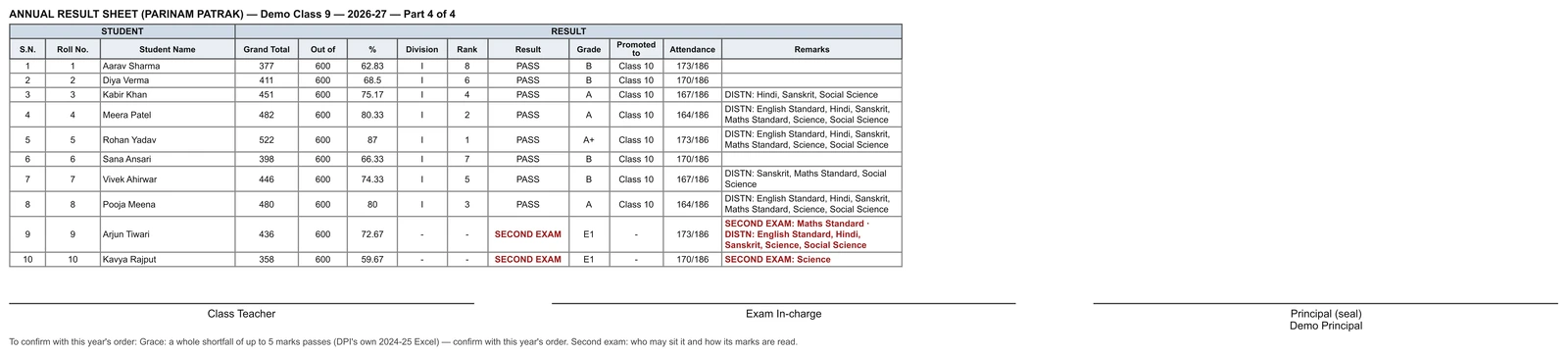 Part 4 of 4: the result beside each name
What goes in
The year’s marks, entered once, in the exams the school already holds.
What comes out
The patrak worked out by the scheme the class follows, locked as a PDF, and the sheets the EMS 3.0, RSK and MPBSE portals ask for.
- Tried with a class of 800 students: worked out in under 3 seconds, printed in about 8.
- A locked patrak keeps its fingerprint (SHA-256), so a changed copy shows itself.
- No AI is used.
The sheets the portals and the office ask for
From the same locked patrak, as PDF and as Excel. Nothing is typed again.
- EMS 3.0 entry sheet: what to type into the portal, subject by subject, in roll order
- RSK and MPBSE sheets, each with its own Excel file
- DEO pro forma 1 to 3
- Sankhyiki Patrak and Vimarsh
- Result summary, merit list and the notice board list
- Second exam (Dwitiya Pariksha) list
- Fail, distinction and promotion lists
- Results compared by teacher, by term and year on year
Papers the MP Board way
- The MP Board pattern: 75 marks in 23 questions, the sections as the board sets them.
- Easy first: the book's own exercise questions, the simplest ones first, the way MP Board schools set unit tests.
- Hindi and English medium: 504 of the 1,118 books on the shelf are in Hindi.
- Your school's header from 108 designs, each already carrying the school's name. No AI, nothing to pay.
The board's lists from Exam Cell
Photo list, verification slips, photo sheet, missing details and award lists, made from the same exam as the admit cards.
Absent on an exam day
A child marked absent in Exam Cell reaches Marks Entry as AB, so the patrak and the result know without anyone typing it.
Try it with your own school for 14 days. No card is needed.